
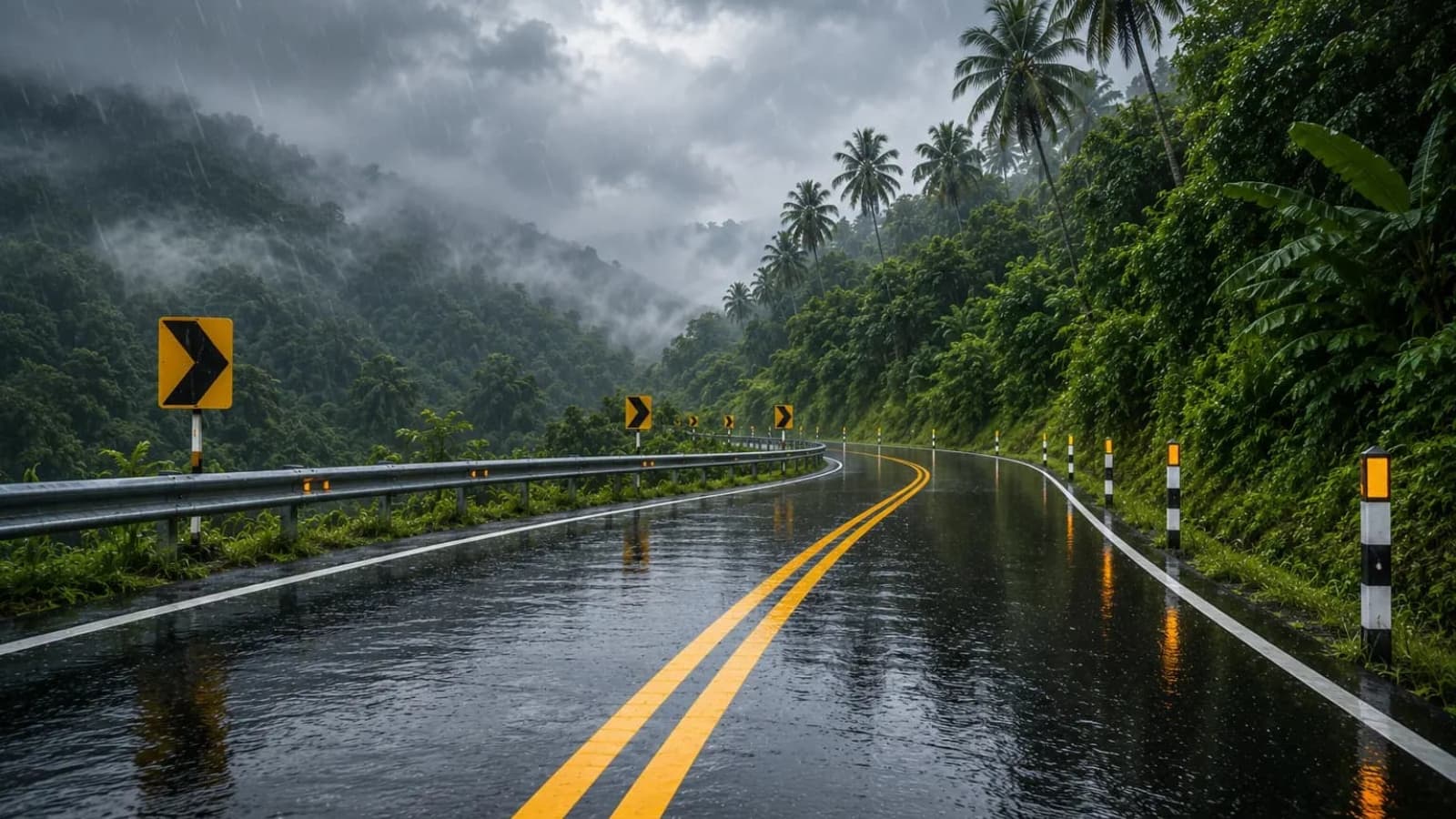
If you've ever driven down a highway during a downpour and struggled to spot the lane markings, you already understand the problem this article is about. In tropical and monsoon-heavy regions like India, road markings take a real beating — relentless UV exposure, standing water, humidity that never quite goes away, and sudden temperature swings between scorching afternoons and heavy evening showers. Ordinary road marking paint simply isn't built for that kind of punishment.
That's where all-weather thermoplastic road marking paint comes in. It's specifically engineered to hold up — and stay visible — through exactly the conditions that break down conventional coatings. In this article, we'll walk through why it matters, how it works, and what to look for when choosing it for rainy or tropical climates.
Most standard paints are designed with fairly mild, dry conditions in mind. In tropical regions, though, roads face a very different reality:
Frequent, heavy rainfall that keeps pavement wet for extended periods
High humidity that slows curing and weakens adhesion
Intense UV radiation that fades color and breaks down binders
Hot pavement surfaces that can soften low-quality coatings
Repeated wet-dry cycles that accelerate cracking and peeling
A thermoplastic road marking paint formulated for these conditions is built differently from the ground up — with resins, fillers, and glass bead systems chosen specifically to resist this kind of stress.
One of the biggest safety concerns in the rain is visibility. A driver's headlights need to bounce light back off the road markings even when there's a thin film of water sitting on top of them. This is where retroreflectivity in wet conditions becomes critical — and it depends heavily on the type, size, and placement of glass beads used in the paint.
Well-designed wet weather road marking paint uses a mix of bead sizes (sometimes called dual-optic systems) so that light still reflects properly even when the surface is wet. This one factor alone can make the difference between a marking that's clearly visible at night in the rain and one that essentially disappears.
Tropical pavement can get surprisingly hot, especially on unshaded stretches of highway. Thermoplastic paint for rainy season roads needs a high softening point so it doesn't deform, smear, or lose shape under heat — even right before or after a storm rolls through.
Roads in monsoon regions don't just get wet once — they cycle between soaked and dry, sometimes several times a day during the season. Road marking paint for monsoon regions needs strong adhesion and abrasion resistance to survive that repeated cycling without cracking, peeling, or losing its bond to the pavement.
It's easy to overlook, but glass beads for road marking paint are doing a lot of the heavy lifting when it comes to night and wet-weather visibility. Beads that are properly embedded, correctly sized, and evenly distributed keep reflecting light back to drivers long after the paint itself has been laid down. Poor bead retention is one of the most common reasons markings look great on day one and dull within a few months.
This is a question we hear often, especially from contractors working on tropical or coastal projects. Here's a quick comparison:
Factor |
Thermoplastic |
Epoxy |
|---|---|---|
|
Wet-weather visibility |
Strong, especially with dual-bead systems |
Moderate |
|
Heat resistance |
High softening point, holds shape |
Can soften in extreme heat |
|
Application speed |
Fast curing, quick return to traffic |
Slower cure time |
|
Best suited for |
Highways, tropical climates, high-traffic roads |
Airport runways, some concrete surfaces |
|
Longevity in monsoon regions |
Generally longer-lasting |
Can degrade faster under heavy rain cycling |
For most tropical and monsoon-affected roads, thermoplastic vs epoxy road marking comparisons tend to favor thermoplastic — particularly for wet-weather performance and overall service life.
Coastal highways — Salt-laden humidity is especially harsh on markings, and road marking paint for coastal highways needs added resistance to corrosion-driving conditions.
Airport taxiways and aprons — Precision matters enormously here, and airport taxiway marking paint tropical formulations need to hold up under both heat and heavy aircraft traffic.
Urban intersections — High footfall and vehicle turnover in wet-season cities put extra stress on markings that need to stay crisp and visible.
Industrial and parking areas — Even lower-traffic zones benefit from formulations that won't fade or peel after a single monsoon season.
Not all thermoplastic paint is created equal, and tropical conditions expose weak formulations fast. When evaluating a supplier, ask about:
Wet and dry retroreflectivity (RL) values, backed by lab data
Softening point and heat resistance figures
Bead dosage and retention performance
Compliance with relevant standards for your region
Real-world project experience in similar climates
Bluelotusafety in Bangalore works with contractors and municipal bodies across India who need road markings that genuinely perform through the monsoon — not just on paper, but on the road.
Choosing the right road marking paint for rainy and tropical regions isn't just a maintenance decision — it's a safety decision. Markings that fade, peel, or lose reflectivity in the rain put drivers at real risk, especially at night. All-weather thermoplastic paint, backed by the right bead system and formulation, is built to handle exactly the conditions that trip up ordinary coatings — keeping roads safer through every season.
With proper application and good bead retention, it typically lasts 3 to 5 years, though heavy monsoon exposure and traffic volume can affect the exact lifespan.
Yes, in most cases. Thermoplastic paint offers stronger adhesion, better heat resistance, and improved wet-weather retroreflectivity compared to conventional road paint.
It comes down to the glass beads embedded in the paint. A well-designed bead mix maintains light reflection even when a thin film of water covers the marking.
Application should ideally happen on a dry, clean surface. Many contractors plan applications around dry spells within the monsoon window rather than during active rainfall.
Yes — formulations designed for coastal and tropical use typically include added resistance to humidity and salt exposure, making them well-suited for coastal roads.